AI Tools for Small Business Owners: Tasks Worth Automating is written to answer a specific reader question with practical steps and clear limits. The guidance below avoids invented first-hand testing and points readers to official resources where product details can change.
Choose low-risk, repeatable tasks first
The easiest place to start is work that is repetitive, easy to check and not responsible for a high-stakes decision. Examples include turning meeting notes into a task list, creating first-draft product descriptions, grouping customer questions by topic, suggesting subject lines, or converting a rough process into a checklist.
Avoid beginning with hiring decisions, legal advice, medical claims, credit decisions or automated customer promises. Those tasks require stronger controls, evidence and accountability than a general productivity tool can provide.
Map the workflow before adding AI
Write the current process in plain language: what information comes in, who checks it, what output is required, and where mistakes cause problems. Then decide where AI can assist. A good design often keeps the first and last steps with a person: a human chooses the source material and approves the final result, while the tool helps with sorting, drafting or summarizing in the middle.
This prevents “automation” from becoming an excuse to skip review.
Keep customer and business information controlled
Before connecting an AI service to email, documents or a customer system, review permissions and the provider’s business data terms. Use sample data during testing. Do not paste passwords, card details, identity documents, confidential contracts or private customer records into a tool unless your business has explicitly approved that use.
Create a short internal rule describing what staff may and may not upload. A simple rule is easier to follow than relying on everyone to make a new privacy decision each time.
Measure the real benefit
Record the time required before automation and the time required after including review and corrections. If a tool drafts a response in one minute but a staff member spends ten minutes fixing it, the productivity gain may be small. Track error types as well as time. Repeated errors often indicate that the task needs better source data, a clearer template, or should remain manual.
Use a limited trial period before purchasing seats for an entire team.
Keep a human owner for every automated output
Someone should be responsible for the final message, file or decision. Customers should not receive fabricated facts, invented policies or a confident answer that no one checked. For public content, verify claims and remove generic wording. For internal summaries, link back to the original records so staff can confirm details.
The goal is controlled assistance: faster routine work while preserving accuracy, privacy and accountability.
Official resources
Key takeaway
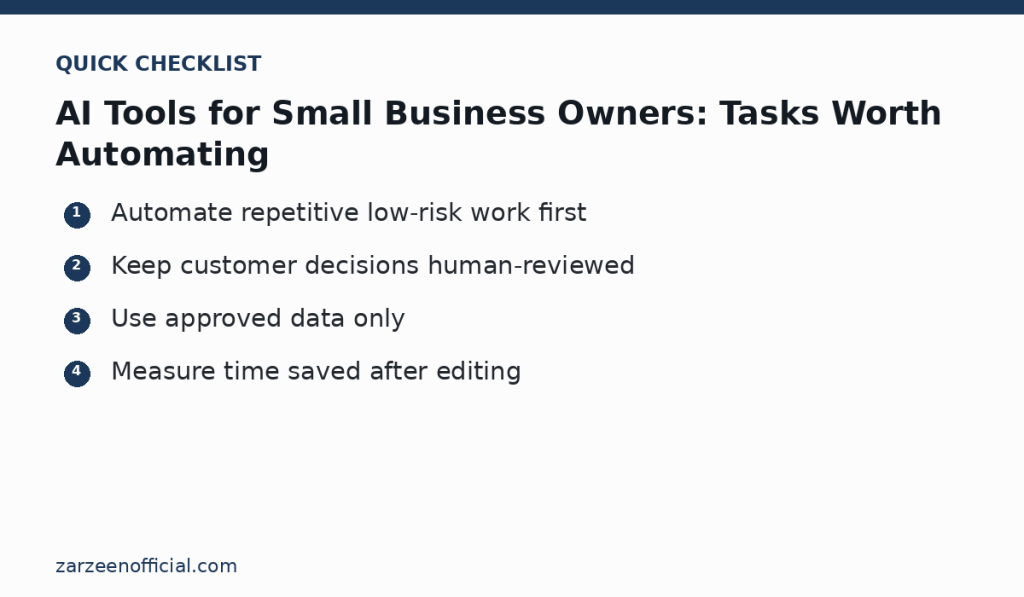
Automate repetitive low-risk work first Keep customer decisions human-reviewed. Use the official links above when a feature, price, policy or security detail may have changed.