How to Use ChatGPT for Research Without Trusting Every Answer is written to answer a specific reader question with practical steps and clear limits. The guidance below avoids invented first-hand testing and points readers to official resources where product details can change.
Use ChatGPT to shape the question
Research becomes easier when the question is narrow enough to investigate. Ask for possible sub-questions, search terms, competing explanations or a checklist of evidence you would need. Then take those ideas to databases, official reports, books or reputable websites. The assistant can help organize the search; it should not become the only source.
Bring verified material back into the conversation
Once you have sources, provide your own notes or excerpts and ask for comparison, themes or gaps. Make it clear that the answer should rely on the supplied material. This reduces the risk of a fluent response introducing unsupported facts. Keep source names beside your notes so you can trace every important claim.
Never accept a reference without opening it
Language models can produce incorrect titles, authors, dates or links. Before a reference enters an assignment or report, open it and verify the bibliographic details and the claim you are attaching to it. If the source is behind a paywall, use the abstract or library access rather than pretending you read content you could not inspect.
Separate summary from analysis
Ask the assistant to label what a source says and what is an interpretation. In your own writing, make the same distinction. A good research paragraph usually combines evidence, explanation and a connection to the question. An AI-generated summary may help you see patterns, but you remain responsible for whether those patterns are supported.
Keep a research log
Record search terms, sources used, key findings and unanswered questions. A log makes it easier to verify a draft later and reduces accidental citation errors. It also shows where the assistant contributed to brainstorming or organization without becoming an invisible source of facts.
Official resources
Key takeaway
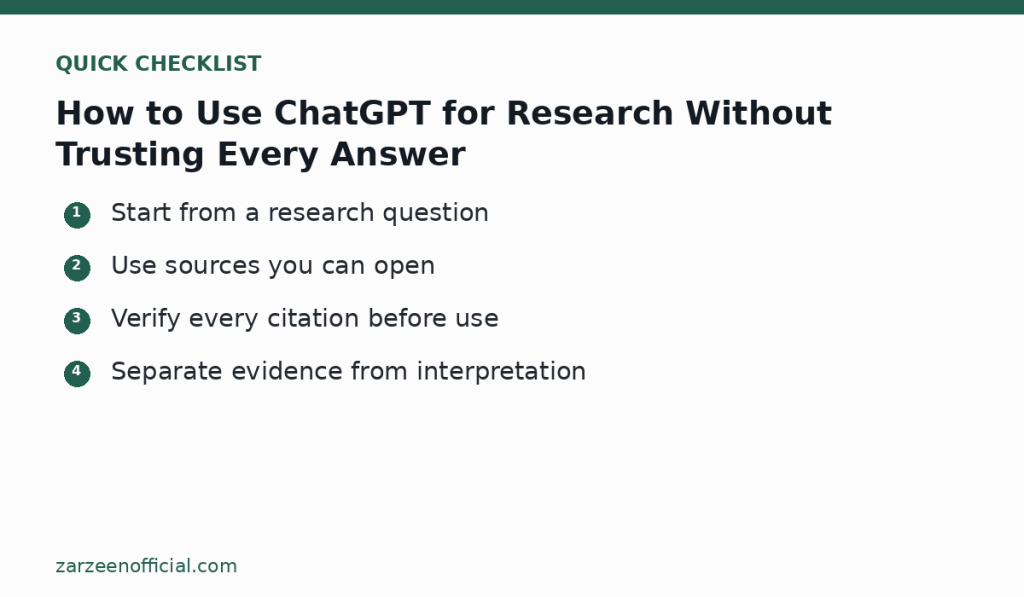
Start from a research question Use sources you can open. Use the official links above when a feature, price, policy or security detail may have changed.